Issue 4: Minute — available to order in print. Order now →

Literary Magazine

NAVY PEN

Voltage

Issue 002

2026

Editor's Statement

When I chose the theme Voltage for our second issue, I wasn't considering a single definition. I was thinking about a feeling: one of those sensations that's hard to pin down but is instantly recognizable. A moment that carries tension, movement, or possibility, even if you can't fully explain why. I wanted an issue that could hold all the different ways that feeling shows up in people's lives.

What we received for this issue blew me away.

Voltage brings together writers from middle school all the way to writers with decades of experience, and the range is extraordinary. The pieces shift in tone, age, perspective, and form, yet they still feel connected. Not because they match, but because each one brings something genuine and necessary to the table.

This issue is also a reminder of something simple but important: none of this exists without people who choose to make things. Navy Pen only works because people, busy people, young people, older people, people in wildly different stages of life, sit down and write. They turn small memories, private thoughts, wild ideas, and uncertain moments into something shareable.

Voltage is a celebration of that choice. A reminder that literary magazines only exist because people keep making art, and trusting someone out there will read it.

I'm so proud of what we've created here. I'm even more grateful for everyone who continues to bring their spark to this space.

Prose/ Essay

I Hope They Die First

By Itzia Medrano

Most of all, I hope my mom dies first.

As her youngest child, born immediately after she lost you, the beloved first-born, I witnessed firsthand what grief to that degree can do to a person. I was created with it; the result of an unimaginable situation our mom could only make sense of mathematically. If you lose one daughter, you add another. Less than a year later, she did. And as I sank into baby clothes damp with their tears, I developed a deep understanding of true sorrow, your first and only birthday gift to me.

Withstanding the loss of another child is not something she would willingly survive. So, as much as it would hurt to lose her, the thought of her navigating this world without two of her babies, a mother with a free hand she doesn't want, hurts more.

And while I'm wishing for things, I hope my sister dies next.

She's looked for you in every man she's ever loved and in the face of every child she's borne. The only way fate could possibly contort itself any crueler would be by forcing her to endure such heartbreak a second time. Your last birthday gift to her was the title of oldest daughter. If I die before her, she would have reigned as youngest, oldest, and only daughter in one lifetime, much too big of an ask for anyone.

In many ways, I am lucky. My birthright is rooted in purpose, something many go their whole lives without. After all, what was I made for if not to help carry their grief? I often spend time trying to assess how successful I've actually been in this endeavor. Has my mere existence provided real comfort or have I been a constant reminder of what was lost? Did they look at me as a baby and regret, if only momentarily, that I wasn't a replication of you? And when I turned seventeen, did they hold their breath for an entire year wondering if the curse had been lifted?

God only knows that if we could switch, I'd agree in a second, giving you a quick hug as we crossed paths and whispering in your ear, "They're waiting for you." Because if, God forbid, I am the first one to die, when they see both of us again, I know that it is you they will run to first.

And so, I pray. I pray that they die before me because while I cannot ever undo their pain, I can endure their loss so that they won't have to survive mine. And at the very end, I imagine that I will hand it all back to God and he might say, "Good work." Maybe you will too.

About the Author

Itzia Medrano is a queer, Latinx writer from El Paso, Texas. She is a Houston-based sociologist and educator whose research has centered on queer studies and ESL education. As a member of the Bahá'í Faith, she is deeply committed to justice, equity, and the oneness of humanity. She is currently focused on memoir and is working on her first novel. Instagram: @itziagirlitzia Substack: @itziamedrano

Notes on Absence, Desire, and the Current That Shapes the Self

By Rashan Speller

I grew up in the incoherence of noise — a city whose nights vibrated with the percussion of gunfire and the guttural chorus of arguments between the forgotten. There was a rhythm to the chaos, a kind of discordant music that filled the hours between dusk and dawn. Even as a child, I could sense the voltage in that environment, the tension between what wanted to live and what had already resigned itself to dying. The sirens, the shouting, the shuffling of feet on broken concrete — all of it composed the overture to my consciousness.

In such a place, safety was measured not by silence, but by predictability. If the same voices quarreled each night, I could sleep. If the gunshots came from far enough away, I could dream. What I could not dream of, however, was the presence of my father. I remember seeing other boys with theirs — the easy way they mirrored each other's gestures, the unspoken transmission of security that seemed to pass between them like light through glass. Watching that made me feel less human, as though I were a diagram missing its essential axis. Their fathers were imperfect, sometimes cruel, but they were there. Presence, in such a world, was holiness.

My mother did her best to fill the space, but masculinity in that landscape was not gentle; it was armor. And because I had none to inherit, I crafted my own from silence, observation, and imagination. I told myself I did not need a father. I told myself I was complete. But every assertion of independence carried the faintest echo of despair, the sound of a child convincing himself he could raise his own soul.

What no one tells you about absence is that it has a texture. It is not a void but a field — electric, humming, capable of shaping everything that enters it. My father's absence became the negative pole around which all my longings arranged themselves. And because I had never been taught how to convert longing into creation, it fermented into desire. When adolescence arrived, it did not arrive gently. My first experiences of what I thought was love were less about another person than about the possibility of being noticed. Attention was the closest thing to affection I understood. Every glance, every smile, every brief acknowledgment sent a current through me — proof that I existed. I confused that voltage for intimacy. And when those connections burned out, as they inevitably did, I mistook the ashes for proof that I had loved passionately.

Years later, reading Jung, I would discover the term anima projection — the process by which a man, deprived of integration with his own inner feminine, seeks her reflection in others. But theory came long after the damage. At the time, I was living through my contradictions: pursuing women not as individuals, but as symbols of validation, as emissaries from a world in which I might finally feel whole. Each new attachment shimmered with the promise of recognition, and each ended with the same quiet desolation. Desire, in my world, became a theology. The body was a sacrament through which I worshiped a god I no longer believed in — the father figure who had never appeared. Physical intimacy created, for fleeting moments, the illusion of being seen. In those moments, I could imagine his gaze upon me, approving, almost tender. It took years, and two different therapists, to understand that this was not love but ritual — the psyche's desperate attempt to complete an unfinished circuit.

The first therapist entered my life during my marriage, at a time when my emotional world had collapsed under the weight of its own contradictions. His office was small, unadorned, painted a neutral color that seemed neither warm nor cold. Yet within that space, I experienced something radical: to be heard without judgment. His voice was measured, neither indulgent nor dismissive. He asked questions that cut through my defenses like clean incisions. "Where does that feeling go when you don't name it?" he once asked. I had no answer.

He offered more than insight; he offered containment. In his presence, I could observe the storm without becoming it. He helped me see how much of my life had been spent reacting — to noise, to neglect, to my own fear of invisibility. Through his guidance, I learned to pause, to insert a sliver of awareness between stimulus and response. Self-control was not repression, he taught, but direction — the art of allowing one's current to flow through purpose rather than impulse. Under his patient questioning, I began to see the architecture of my own behavior: the patterns of anger that masked fear, the detachment that masqueraded as strength.

Still, there were currents he could not reach. My marriage, fragile to begin with, cracked under the accumulated weight of misunderstanding and projection. When it ended, I mistook the dissolution for failure, but in retrospect, it was the necessary dismantling of a self built entirely on survival.

Years passed before I entered therapy again. The second therapist was different — younger, more direct, with an intensity that mirrored my own. The first had been a stabilizer; the second was a catalyst. Our conversations were less about restraint and more about recognition. He understood the subterranean link between erotic longing and paternal absence. When I spoke to him, it felt as if I were looking into a mirror that finally reflected not only my face but the invisible machinery behind it.

He helped me see how my pursuit of intimacy had been a coded dialogue with my father's ghost. Each encounter, each fleeting connection, was an unconscious reenactment of that first abandonment. The pleasure was real, but beneath it pulsed a grief I had never allowed myself to feel. To seek approval through connection was to repeat the wound under the illusion of healing it. In confronting that, I began to understand that what I had mistaken for desire was, in truth, the psyche's attempt to re-enter the scene of its original trauma and rewrite the ending.

These insights arrived like shocks — small but cumulative. Therapy became less a conversation and more an experiment in consciousness. I began to notice how the body records absence: the tightening of the chest when someone withdraws affection, the way silence echoes louder than noise. Slowly, I learned to interpret those sensations not as enemies but as signals. The body, after all, is the first text the psyche ever writes.

I also reflected on the institutions that had shaped me. The schools, the streets, the churches — each functioned as a machine designed to convert energy into compliance. In those "ghetto institutions," survival required emotional muting. The teachers wanted quiet, the preachers wanted obedience, and the streets demanded vigilance. Voltage was dangerous; it attracted attention. And attention, in that world, could kill you. So we learned to hide our brightness, to keep our ambitions low, our feelings lower. To want too much was to invite disappointment; to feel too deeply was to appear weak.

But what those institutions could not extinguish, they inadvertently concentrated. Beneath the surface calm, I carried enough unexpressed energy to light a city. It leaked out in inappropriate places — arguments, obsessions, reckless choices — until therapy taught me the one lesson the streets never could: that transformation requires containment, not explosion.

Jung once wrote, "one does not become enlightened by imagining figures of light, but by making the darkness conscious." My darkness was unacknowledged grief: the nights spent listening to arguments outside, the mornings watching other boys with their fathers. By bringing those fragments into awareness, I began to rewire my internal circuitry. What had been a chaotic surge of impulses became, gradually, an intelligible current. The past was not erased. Trauma does not vanish; it integrates. The old sounds remain — the echoes of gunshots, the distant arguments — but they no longer dictate the rhythm of my mind. Even the memory of my father has changed timbre. I no longer see him as a void to be filled, but as a shadow that defines the contours of my light.

The work of both therapists converged in this understanding. The first taught me regulation; the second, revelation. Together they enabled me to conduct rather than discharge my energy, to channel it into creation instead of consumption. Writing, thinking, mentoring — these became the new conduits for what once expressed itself destructively. Even now, I do not claim peace as a permanent state. There are days when the old restlessness returns, when the city's noise seeps back into my bloodstream, and I feel the phantom pull of the past. But I have learned to listen differently. The gunshots are not omens; they are reminders of what I have survived. The arguments outside are echoes of a world still learning to articulate its pain.

Now, when I consider the concept of love, I do not imagine ecstatic fusion. Love, I have learned, is not voltage but resonance — the steady hum between beings who have learned to hold their own current without extinguishing another's. It requires self-knowledge, boundaries, and the humility to recognize that no one can complete what was never missing, only awaken what was dormant. If my father were to appear now, I suspect I would not ask for explanations. I would thank him, not for leaving, but for forcing me to seek the masculine within myself. His absence, once unbearable, became the negative space through which I defined my own form.

The philosopher in me knows that individuation is endless; the human in me still hopes for rest. Between those truths I live, humming quietly, neither saint nor cynic, merely a man who has learned to conduct his own current. And when I walk through the city at night, past flickering neon and the low murmur of distant lives, I no longer feel apart from it. The same voltage that once terrified me now feels like kinship. Perhaps that is all enlightenment ever was: not escape from the world's electricity, but participation in it with awareness. The fatherless child has become his own conductor. The current hums. The light holds. And in the quiet after the strike, recognize not peace, but presence — a measured hope vibrating in philosophical silence, the kind that hums quietly beneath all chaos, steady enough to illuminate the self I have finally begun to inhabit.

About the Author

Rashan Speller is a Philadelphia-based writer who began writing as a means of healing—an act of survival and self-discovery. His work wrestles with trauma, masculinity, and the unknowable patterns that shape us. With a philosophical lens and poetic grit, Rashan writes to make sense of what resists explanation. His work has appeared in Flowermouth Press, The Unsealed, Collide Zine Magazine, Creation Magazine,The Words Faire, and other publications

Currents

By Kate Gliniecki

Tears flood down my face. Wipe, breathe, try, repeat. I used to be so smart. Why is everything so hard for me now? Why should I even try? My eyes drill into the list in front of me: Math packet, Read 30 pages, finish science lab, workout. Two hours to do it all before I go to practice. I can do this. This was a pattern I found myself in throughout most of seventh grade. For the first two years of middle school, I worked for hours each night on extra credit, redoing assignments that were already good enough, making sure everything was as perfect as possible, even beyond what it was being graded on. Quickly, this led me to burnout.

Somewhere deep inside me, I still possessed that drive my younger self flourished in, and all I wanted was to get that calmness back. In the year prior, my commitment to dance had intensified, and though I was still committed to school, I was on a learning curve balancing how to split my time with a new, additional focus. It was hard to give myself grace through the transition, so I stayed upset with myself Instead, I was stuck in a cycle: I'd start an assignment, but as I realized I wouldn't be able to finish it as fast as I wanted, I'd start to stress and figure out what I could do to speed up, which would waste more time, which would stress me out more, and I'd wind up needing to cram everything into 30 minutes, ultimately frustrated that if I hadn't overthought it, I would have been able to finish everything. I wanted to control how long assignments would take me and how much motivation I had. I wanted to control the burnout so that I could be as perfect as my middle school self.

I had been a perfectionist for my entire life and always held myself to very high standards, because I felt like if I wasn't doing the best, I would be letting someone down. When my parents would say, "Do your best," I heard "Be the best." Even in preschool, my teachers told my parents how quiet and well-behaved I was, and I already took pride in being seen as "good." Since I had always fought to please my parents, I thought that by having control over everything, I would be able to do so without issue. Because seeking this "total control" was inevitably impossible, it led me into spiraling.

Going into 8th grade, I was still making an attempt to control my time in unrealistic and perfectionist ways. Thoughts like "new year, new me" played in my head as I got ready for school to start. This could have been an opportunity for me to change my ways, but instead, the pressure of the new year and new chance to become the perfect version of myself made it even worse. This cycle had been ongoing for almost two years, and I was at the depths of mental and physical exhaustion. Now everything, even the sport I loved, felt like hours of manual labor, but this had become so routine that I couldn't see the signs my body was giving me.

A month into my second semester in 8th grade, I suffered a severe ankle injury, and after striving for perfection for years, I was out of dance for months. All that dedication just to face a major setback that felt impossible to bounce back from. The first time I went to the doctor, they had told me it was broken, but this didn't sit right with me. I had broken a bone before, and this just wasn't the same, but they were professionals, so I assumed what they said was right. I let things play out until my injury wasn't improving. I went back for another diagnosis, and my heart almost stopped beating at the response.

"Your injury was treated wrongly in a way that has caused permanent damage." Said the second doctor.

My heart sank. My throat tightened. My hands fisted with rage. At first, I wasn't sure who to be angry with, whether it was myself or the doctors, or the injury itself. I wasted so much of my energy for the next two weeks just trying to figure out someone to pin the blame on. Feeling that the doctors were to blame, it sank in that my fate was in the hands of people who had lost my trust. I had reached a new low point, feeling so disordered that I knew I couldn't afford any further mistakes. So, I took control.

"Fake it till you make it" became the phrase I lived by. However, this only set back my progress because I would push myself further than what I was ready for. This cycle had repeated three or more times until I realised I had no control. Other than my physical therapy, there was nothing I could do to speed up the recovery or fix anything. No recovery date I set was true. No medication would heal me quicker. As much as I wanted to hit fast forward, I was forced to live through it beginning to end.

My mindset started to shift from denial to surrender as I realized I didn't possess all the answers. Instead, I began using my frustration to fuel myself and focused on the things I could do while my ankle healed. I was on the edge of recovery and was letting myself take things slow. I began to realize that accepting life as it comes and responding to what I have in front of me is easier than trying to change things to fit my ideal reality. As weeks passed and my ankle finally had the space to heal, I started dancing more, until I was finally able to go to our last competition.

It was that weekend that made me realize the world didn't end when I lost control. Everything went on as usual, and I realised this was one of those times that the world was happening to me. And sometimes that's ok. I learned that moving with the flow isn't always easy, but it makes the process less painful. My mind became decluttered of stress, and focus came with more ease than before.

Ever since the injury, my way of approaching life has shifted intensely. I came to terms with the fact that controlling everything is impossible and sometimes more harmful than useful. I focus on looking for what I can do about a situation, and if there's nothing I can do, I wait until something happens that I can react to instead of trying to make an unfixable situation fixable.

This new approach has given me more freedom to occupy my mind with more important things than stress. I came to the understanding that perfection does not mean greatness. Being great is about being able to react and interact with your surroundings to make yourself the best version of yourself. I used to think giving up my control would also mean giving up my freedom to do what I want, but honestly, I've never felt so free accepting life as it comes.

About the Author

Kate Gliniecki is a Sophomore in high school in Milwaukee, Wisconsin. Outside of school, she is involved in a competitive dance studio and mainly performs in the styles of contemporary, jazz, and classical ballet. This is Kate's first time pursuing publication in personal narrative writing. Kate hopes that this piece will help readers understand that they do not need to be perfect in order to achieve great things.

My Mothers Plans

By Rose L.M. King

I wanted a bunk bed. Was my room way too small for one? Yes. Was I 10 and determined to convince my parents that they were wrong because clearly as a 10-year old I have a brain far superior to theirs? Yes. Staring at the miniature version of the real thing on display in my local Walmart I was staring right at my dreams, well one of them at least, my biggest one was to become Hannah Montana, and only now do I know that I'm not that cool, but I've watched Black Mirror, so, enough said.

I know I was being a brat now, but then, no, I could never. My mom, on the other hand, will never admit to being immature. Acting just a few years older than her 10-year-old daughter for longer than I had been alive. Innocently or not, I've asked her, and she says she doesn't remember, so an answer to that question will not be found. She told me something that still haunts me to this day.

"You know your aunt and I had bunk beds as kids and I would have kept them if I planned on having kids." Now because I had a superior 10-year-old brain, I vastly understood what she was saying. Planned. Planned what? Parenthood? We both know because of her religious trauma that she could never support that kind of thing. And yet, here I was. Standing under the humming fluorescent lights in my local Walmart, holding a Barbie doll that I knew would never call my house a home, being made unwilfully aware that I, in fact, was technically a mistake.

My dad told me that I was the best "surprise" he could have asked for. But sometimes surprises aren't fun, like the surprise he thrust on me, 22 years later after his little surprise had been unveiled to the world, he told me that I would have to stop using my voice to help those whose voices had been suppressed just by existing, or else I was no longer welcome in the house that had never felt like home. The same house that just years before that I had left, and when my mother had left him with nothing but the sad broken-down shack of a house and a hefty amount of debt and trauma, he begged me to move back home so he wouldn't have to be alone for the first time in his life. Unknowingly or not, he was telling me to silence my voice just because of the situation I was unwillingly brought into.

Planning was always my mother's thing. Except for my arrival in life. The announcement of my creation was not a plan that my mother had had. But after she got to work on pretending she did. My mother so meticulous; planned out my life for me before I had even become separated from her body. You see, because I was the one thing she hadn't planned for in her life, it was my job. My unpaid, hard labor, backbreaking job, to make sure every one of her plans for me never came true.

After doing this for years my father finally decided to follow in my footsteps and give her another unplanned surprise. He left. But that was my plan all along, I knew that if I didn't leave them, they would never leave each other, without me around to be the martial glue, in a shitty arts and crafts piece that was never meant to stay together, their plans to stay miserable together would not go through.

I was unplanned. But even from the beginning, before I developed my superior 10-year-old brain, my plan has always been to obtain the thing my mother was never told to plan for.

Happiness.

About the Author

Rose L.M. King is the author of Just Another Book About Sadness, a poetry collection exploring grief, identity, and resilience. A queer, disabled, and neurodiverse writer, Rose is currently working on an autobiography, a book on ADHD in AFAB people, and new works of fiction.

Hooked on Understanding

By Lillian Meehan

"Mathletes, take your marks, go!"

The clock projected at the front of the lecture hall begins counting down from 40 minutes. I stare down at the packet of problems with an exciting mix of confidence and nerves. I read, "Let n be a positive integer less than or equal to 1000. If the last two digits of n are reversed, the resulting integer is exactly 85 percent of n. What is the sum of the possible values of n?"

I try to set up a few equations and inequalities: n≤1000, n=100a+10b+c, 0.85n=100a+10c+b. Still, I don't know where to go from there, so I skip ahead. It's frustrating to give up a point, especially after weeks of practice, but that's the reality of competitions: you can't spend forever on one problem. Skipping once feels manageable—but after skipping the next question and the one after that, it begins to feel crushing. Blank pages pile up. The clock ticks down from 35 to 30 minutes, and a quarter of my time has evaporated without a single solution. Finally, I hit the last page. No more problems left to skip, nothing left to push out to later.

I've loved math for as long as I can remember. From competing to be the quickest in my second grade class at reciting my times tables, to the comforting feeling of getting perfect integers after solving a system, looking forward to math class has always been a constant in not only my school day, but my entire life. One of my earliest memories with my family was when my parents would hold up multiplication flashcards at the kitchen table to see how fast I could answer a hundred problems. I raced to shout the answers as soon as I could see the problem, giggling when I beat my best time. The only strategy I knew was to speed-run everything. There's a kind of instant gratification in math that nothing else gives me – one solution, one clear answer, everything neat and logical. And I loved the competition too, not just the winning, but the way it pushed me to climb higher levels, learn new topics, and think in entirely new ways. So when I found myself staring at a problem set full of words I didn't know, questions I didn't even understand how to begin, it was crushing. I wasn't used to feeling completely stuck in a subject I loved so much. The confidence I normally carried into math rooms evaporated. All that was left was doubt.

Almost twenty minutes in, and I'd barely written a thing. I looked around to see rows of other students tapping their pencils and scratching their heads. I could tell they were just as confused. For a moment, I felt a surge of short-lasting relief until I looked more clearly and I saw the occasional student light up with a smile and jot something down. What I noticed about all of them, though, is that no one else was frantically skipping through pages. Even the students who seemed stuck were concentrating on the problem they were on, not rushing to see if another one seemed easier. So I realized my best option was to slow down. No more glancing around to see if others were understanding or skipping questions, or peeking at the clock. From now on, I had to just focus on just the next step of the problem I was on. I flipped back to question one and forced myself to look again, trying to set the pressure aside and just understand. I circled terms, underlined what I did know, and let myself move slower than I ever had during a competition.

My mind, still restless, flickered to something entirely unrelated: the crochet shark I'd been working on that week. The slow, repetitive motion of pulling one loop through another, over, under, over, under. Each stitch building on the last, just like the result of each equation led to a new equation that was one step closer to the solution. I reread the first problem one more time, as if unwinding a fresh ball of yarn for my next crochet project, I set up my first equation, n = 100a + b, the first stitch, then expanded it further, n = 100a + 10x +y, the next few stitches around the first ring of the project, then switching the digits, n' = 100a + 10y + x. The first ring of the project was done, now for the next row, n' = 0.85n. With each new equation and new row, I was one step closer to my final product. I'd never rushed crocheting a piece; the risk of messing up a row was much greater than the reward of being able to get the project done a little quicker, but it always grew into something whole. Maybe math isn't too different. I didn't need to solve everything in one brilliant flash. I needed to go stitch by stitch.

I didn't win that day, but I learned that when something isn't working, the solution isn't just to abandon it; it's to find a new way forward. Even if that means slowing down. I learned how to zoom in and see what was actually in front of me instead of obsessing over the big picture. In practice, I focused more on understanding the reasons why a formula worked or the thought behind finding the solution, rather than memorizing random patterns that lead to an answer, and being able to understand every stitch of the solution, instead of just racing for the final result.

Furthermore, I realized the connection wasn't only between math and crochet; I could see this need to take a step back in many aspects of my life. In debate, during the two minutes of prep time we get between speeches, I wouldn't stress about not being able to find the perfect argument in a split second, but instead I would flip through a few relevant sources to find the perfect statistic to prove a point. In piano, I practiced difficult pieces measure by measure, layering progress slowly instead of expecting perfection in one go. I realized just sticking through things, no matter how slow the process feels, is what gets results. Instead of getting up and shutting the piano when a piece doesn't click the first time, I could at least manage to learn a couple of notes or measures by slowing down and allow myself to take some time to understand. I found this was more fulfilling because I actually understood how I reached the answer, rather than feeling as if I was racing blindly towards completion.

Now, when I meet something unfamiliar, like an equation, a debate, or a new crochet pattern, I don't rush past it. I zoom in and slow down, and most importantly, keep going: one stitch, one step, and one question at a time.

About the Author

Lillian is a sophomore in high school in Moorestown, New Jersey. She is an avid crocheter, specializing in mini stuffed animals. Additionally, she competes with her school's math club. Outside of school, you can find her watching Grey's Anatomy, going to debate club, or heading to swim practice. This is Lillian's first endeavor into personal narrative writing, and she hopes anyone who reads her essay remembers the importance of slowing down and appreciating the moment, rather than blindly rushing towards the finish line.

The Magpie

By Stix Eris

Her eyes bolt open. She can feel the energy coursing through her body: zipping from her fingers to her toes and back again like a circuit. She twitches, trying to banish the feeling from her body to no avail. Finally, she sits up and slips out of bed, putting her feet on the cold wood floor. She sighs, resting her head in her hands- still wrapped with gauze from the night prior. "Keep these on," Miracle had instructed. "It'll help." She can see her sister's eyes, filled with deep concern, as she knelt by the hospital bed. But underneath her worry was something much more sinister: fear. She is used to that look by now, especially from her family. It's the same one they gave her after she was released from rehab or before she got that bone marrow transplant as a child: as if she would spontaneously combust if they stared at her for too long.

It wasn't entirely fair. She was only a mess in comparison to her sister. Having been born a few seconds after her, Miracle was something of a surprise and she remained the golden child ever since. With her graduate's degree, successful career and perfect boyfriend- she is hard to contend with. So, Mallorie stopped trying. She decided to stay in her sister's shadow and tried to find comfort in it. But it had become increasingly difficult- considering Miracle's recent foray into masked vigilanteism, making her an overnight sensation.

Now, her face is all over the city: on posters, in commercials and waving on the flag outside the governor's office. People worship her and it's just as nightmarish as it was at every single piano concert, ballet recital and graduation speech. She still remembers her parents wiping their tears as they rose to their feet for every single standing ovation. While she sat quietly in the corner, dying for a smoke break.

They call her the Mage- which makes no sense to Mallorie. To be fair, she has no real power- just a brilliant mind and a penchant for tinkering. And while the denizens of Sterling City are dazzled by her array of sparkling magic tricks and glowing weaponry, Mallorie can see quite plainly that it is all smoke and mirrors. Just like most of the city: filled with uppity rich folks and dazzling smiles that hold no warmth beneath them.

Meanwhile, the Marr teems just below the surface- full of unmentionables that the Sterlites would prefer to forget. But when Miracle came along- she vowed to protect the city from the crime that constantly threatens to drift up from the Marr's seedy underbelly.

It fills Malorie with guilt to know that- by all counts- she should be down there, among the underworld with sweat on her brow and dirt on her face, working tirelessly on the power grid that keeps Sterling City bright, clean and shining. She knows full well that, if not for her parent's money, that's exactly the life she'd be living.

Meanwhile, she works a useless job and has a habit of stealing wallets from other people's purses and slipping baubles into her coat pocket on her way out of the department store just to feel something. She doesn't know why she does it. Perhaps the rush reminds her that she's alive. Or maybe she is simply fulfilling the prophecy her parents laid out for her: the dead beat daughter with more addictions and bad habits than one can count.

But the jolt she gets keeps her alive and the rush is all she's ever known. Her rehab therapist described her as having "dangerous fixation and deep need to possess what others retain." As heady as the wording was, Mallorie had to agree. There had to be something behind her desperate need to hoard the cafeteria forks. Not to mention her unfortunate addiction to snagging her roommate's jewelry. Her classmates took note, earning her the nickname: "The Magpie." Miracle latched onto that pretty quickly- keeping the nickname alive way past its expiration date- much to her parents' confusion. Eventually, she shortened it to "Mags" but the sting remained intact.

To say that their relationship became strained would be an understatement.

After graduation, Mallorie kept her distance. She filled her body with every possible drink and drug, staying out late and sleeping with as many strangers as could find. She was happy to indulge in whatever landed in her lap. But when the Mage appeared on the scene- it reeked of Miracle's usual flashy air. Somehow, she connected the dots. And when Miracle magically started calling again, it was easy to pull the information out of her. But Mallorie had already walked too far down the proverbial road of resentment and Miracle's recent stardom was further proof that she would do anything for attention. It was also further proof that she couldn't trust her sister- no matter how hard she was trying to pretend otherwise. And no matter how many wine nights, brunch spots or movie dates Miracle offered, Mallorie was never convinced.

It all came grinding to a halt when, as per usual, she was in the wrong place at the wrong time.

The Makers Market was her favorite spot to steal. Amongst the moving bodies and teeming shops, it was remarkably easy to sneak away with whatever she laid her hands on. The day had been like any other, Mallorie was just slipping an ornate deck of cards into her pocket when a commotion broke out at the far end of the Market.

People were scattering this way and that- crying out in dismay. She lifted her head to see a man, presumably from the underground, stomping in their direction with Miracle in tow. There were whispers that the Marrites were starting to mutate- thanks to being constantly exposed to a multitude of toxins every single day. Multiple limbs, oozing sores, hair loss- it seemed too silly to be true so she had dismissed it as mere fear mongering. But she saw with her own eyes that the rumors were true- at least, in this case.

The man was bald with fists made of flames and fire pouring from his eyes. It reminded her of something she had seen in the nightclub after too many tabs. Something that would make her question her very existence and leave her haunted the next day. But it was as real as daylight and she could scarcely believe her eyes. He was spitting fire at the caravans, disintegrating rugs and souvenirs and toys into ash. Miracle was trying to stop him- with little success.

She found it kind of amusing, in a way, to finally see her sister getting humbled. Suffice to say, her sparkly tricks were nothing in comparison to actual, superhuman power. She wondered, for a moment, if she should help, try and distract him somehow- but she remembered how many times Miracle left her to rot and she decided better of it. It wasn't her path, so it wasn't her fight. Let her sister get her ass kicked for once. Maybe she'd learn something. Maybe people would finally see her for who she really is. But, even as she willed herself to move, she found her feet frozen in place, still too shocked at the sight before her.

"Mags- get out of here!" Miracle cried out, waving her hand in the opposite direction. They both seemed to realize, simultaneously, that this was a major mistake. The man tilted his head in her direction, seemingly seeing her for the first time. An eerie grin spread across his face before he sprinted directly at her, knocking her to the ground.

She awoke, hours later, surrounded by shadowy figures. Her head ached from the impact. Among them, the same man from before. But this time, his skin held no flame- just the remnants of ash, smeared on his face in ritualistic symbols. He was raising his hands to the heavens, crying out words she couldn't quite decipher. He looked down at her, smiling placidly, and continued his diatribe. She shut her eyes, trying desperately to understand what he was saying.

"Brethren, we have been crushed under foot for too long. We will no longer be made to serve the greater populous. We will rise up. And with us…a new kind of warrior!" He looked down at her- his eyes ablaze with a holy passion beyond her comprehension. She wanted to cry out under the weight of his gaze- wanted to wriggle off of the cement slab they had tied her to. "My children…come and witness the holy sacrifice. We will bestow a gift upon her. And in return, this Upperworlder will know our pain. She will become our voice, our righteous right hand. She will bring the city to its knees."

She struggled against her restraints to find them horrifically intact. He noticed her movement and held her down under his knee, crushing her lungs. "Soon, little one, you will understand your purpose. You will know your own power. You will become one of us." She did not understand, did not know why she of all people, had been chosen for whatever gift they wanted to bestow. She was under no allusions that this gift would not be a pleasant one.

He reached down to cup her face. "Little one, do you desire a better life?" She licked her cracked lips, swallowed in an attempt to wet her barren throat. "Do you?!" He called out, leaning so close that his spit landed on her cheek. She nodded, trying to appease, terrified of the outcome. "Do you tire of your gilded cage? Of the prison to which you were born?"

"Yes." The sound escaped her lips before she had time to think.

"Good!" He grinned, a terrifying, devilish short of grin. He stood again, addressing the crowd. "Then, gather close, my children and witness transformation; witness freedom."

The crowd drew closer, their eyes full of wonder. Amongst them there grew a terrible hum- a droning buzz that overwhelmed her senses.

"My children, come. Offer your hands to this great mission. Let us give her our gift." She watched, her lungs full of terror, as the crowd surged forward- shoving at the cement slab, pushing it upright. She found herself facing an acidic pool- bubbling with numerous toxins. A scream erupted from her throat as she realized that this gift was no gift at all: it was certain death. They had convinced themselves that she would somehow rise out of his pool with powers unknown- like their leader- and offer them freedom in the form of destruction.

She began to beg, pleading with them to let her go. But they would not hear her. Their droning hum became louder and louder by the second until the leader raised his right hand high in the air. Silence settled like a knife shredding through a string- breaking the tension.

"The Gift… We give it freely," He proclaimed. The crowd responded in turn, repeating his words until it became a chant. "Let this gift sustain, let this sacrifice rise again." Raising his mighty hands, he cried out: "Witness!"

Like a flash of lightning, they slashed her ropes free and dropped her into the pool. She struggled against the goo that ate at her like quicksand. Finally, it devoured her whole. Her lungs burning, her eyes going blind with the neon green muck that surrounded her. She tried to scream but couldn't, thrashed against the oppressive liquid until her limbs were sore from exertion. She sank further and further until her feet touched the bottom of the pool and the acid settled around her, crushing her.

She thought she would die after too many pills or maybe a bad hookup. But being killed by a cult was not on her bingo card. She thought of Miracle and her parents- wondered if they'd search for her or write it off as just another failure. Perhaps they'd be happier without her. Finally becoming the perfectly formed family they always hoped they could be. She shut her eyes tight, feeling the life beginning to leak from every pore as the poison overtook her, bonded with her, became part of her DNA.

She began to write a eulogy in her head that no one would hear- for a funeral that would never occur. Here lies Mallorie Kline- she died like she lived: unfortunately. She would have laughed if she could've. She felt the toxins enter her bloodstream, noticed how dizzy her brain became- almost euphoric. This is death, she thought, quiet and anticlimactic with no fanfare or family to send her off.

Until she felt the muck begin to shift. She wondered, bemused, if perhaps her soul was ascending. She hadn't given much thought to the afterlife. She merely hoped it would be like an afterparty- full of never-ending booze and laughter as old friends reunited and new lovers kissed in the corner.

When she dared to open her eyes, she realized she was floating high above the onlookers, her feet dripping with slime. They looked up at her, clasping their hands as if to pray. Some of them wept tears of joy while others cried out in victory. For a moment, she felt hope- felt relief. She gazed at their faces and felt sympathy for them. She considered, for the first time, that maybe she could be the hero they hoped she would be.

And then Miracle appeared to rescue her, in all her glory, and Mallorie tumbled back down into the pool. She awoke in the hospital a few days later to find her sister at her side, anxiously waiting her return to consciousness.

It didn't take long for the toxins to reveal their work. It was small, at first. A muscle spasm or an electric shock when she gripped metal. But when a nurse touched her arm and wound up electrocuted into an early grave- the doctor confirmed her worst fears: the poison had changed her genetic makeup completely. Whatever this ability was, it was part of her now. She had to learn to control it, to mask it, to smother it completely.

Miracle brought her back to her dingy apartment- stayed with her for days. She begged her not to tell anyone, not to use her powers until they knew more about them and could find a cure. And when she finally took her leave, she left Mallorie to her own devices. The doctors insisted she stayed in bed for at least a month while they ran various tests on her blood samples, trying desperately to find any way to reverse the damage.

But Mallorie wonders if maybe it isn't a curse at all. She wonders if, maybe, she could find a way to use her powers to do something useful.

An idea forms in her head. She slips off her socks and pads over to the window, sliding it open. Outside, the rain pours down on the pristine streets, catching like pearls in the street lamps. She places a delicate foot onto the fire escape and steps out into the night air. She climbs the ladder until she reaches the roof.

The rain pours down- soaking her hair and clothes. She unwraps the gauze around her hands, slips it into her pocket. As expected, the weather makes it easier to feel the energy coursing through her veins. Sparks dance over her skin, enticing her to use her newfound abilities. She stamps her foot down, watches as the electricity travels underneath her skin. A set of sparks emit from her foot and travel through the puddles to fizzle out into the ground beneath her.

She takes a running leap off of the roof, hurling herself into the air. She panics, for a moment, and then wills the electricity to shoot through her fingertips. To her shock, it obeys. Her fingers burn deliciously from the jolts that spread out in a mass of directions, connecting to the buildings around her. The energy pulses, pushing her up into the air and safely onto the next roof.

The feeling is unlike anything she's experienced before. It feels like she is a part of the ecosystem. As if, there was a part of her that always was more powerful than her human body and, now, it is free to escape its confines. The cage door is open and the animal within her can finally reach its full potential.

For the first time, she feels powerful, capable. It strikes her as ironic that she has unimaginable powers- where her sister merely pretends. She wonders what her parents would say but knows all too well that they'd respond with doubt, concern and confusion. They would not celebrate her power. They would not consider the positive changes she could create. They would be afraid that she was incapable of using it and therefore unworthy.

The feeling makes her sick.

She looks down at the ground. She knows the Marrites can relate to her plight. She can glimpse the movement just below the surface, through various cracks and crevasses that make up the spotless skin of Sterling City. Beneath it all is a teeming underworld, cramped alleyways of people selling their wares and seedy denizens jostling this way and that- all lit by dim lamp light that casts an eerie glow on the weary faces passing by.

Her heart pangs. She feels for them- those faceless people who can only live as servants, simply because they were not born rich. Meanwhile, Sterling profits off of their blood, sweat and tears -growing more and more swollen with indulgence because of it. Very few of these stragglers get the opportunity to escape their imprisonment and the few that do are barely able to make a life above Marr because of people's prejudices. Most of them have slunk back below to be with their families- unable to withstand the gossip behind people's hands, the wary gazes and the refusal of service. Sterling offers them one option: turning to a life of crime to survive only to be punished for it.

And her sister help enforce this, gleefully handcuffing criminals and leading them to their jail cells.

She tries again, launching herself off the roof and using the electricity to help her flip mid-air before she slams down onto the third rooftop, rolling to break her fall. She's beginning to think she may have found something that she is actually good at. The thought fills her with an unfamiliar burst of enthusiasm. She knows this feeling will become an addiction for her. She already cannot imagine living without this insatiable energy that brings her to the brink of overload in the most delightful way.

A few yards away, the train screeches- drawing her attention. She can feel the white lightning traveling through the wires beneath the metal structure. It calls to her. She steps off of the rooftop and lets the city's pulsing electric grid lift her into the air and off towards to train.

She slams down onto the tracks, feeling the energy flowing through the metal. It enters her brain. It fills her lungs and makes her feel even more powerful than before. A laugh escapes her lips and a new idea forms in her head- an awful, evil, malicious idea that sends a chill down on her spine. If it was any other day under any other circumstance, she would ignore it- let it drop through the floorboards and pretend she never thought it.

But instead, she feeds it like a pet. She indulges it, lets it grow bigger and bigger- taking up more space in her head. Her first step? The shopping district. She has a few items to pick up.

When she arrives, she makes a beeline for the most swanky boutique in town- a place that has denied her entry more than once.

And there, in the front window is a large poster Miracle- grinning ear to ear- holding a magnificent bag aloft. The text above her reads: "Our Millennium Makeup Bag : Mage Approved ™!" Anger wells up inside of her. Miracle's smile- peeking out from beneath her blue latex mask and brown hood- seems to laugh at her, goad her. She wants to punch through the wall of glass and tear it down. And maybe, with her new abilities, she can do just that.

She can feel it buzzing inside her exoskeleton- zipping anxiously around her spinal column like an insect. She wills it to rise up through her ribcage, passing through her organs leaving a delightful tipsiness in its wake. It slinks up her throat and she holds it there. She places her fingers on it- feels the warmth of the blue energy fizzing underneath her skin. She gazes at the poster again and lets her rage pool within her- starting at the pit of her stomach and hurling it up into her chest.

She opens her mouth to scream- letting out every insecurity, frustration and rejection in her bones- releasing the electricity from her throat. It crackles out of her lips shattering the window pane. She smirks to herself and places a delicate hand on the window frame to step into the boutique.

The coat has been calling to her for weeks now- but she hasn't been able to figure out how to nab it. But now, it's hers for the taking. It's a long, red overcoat with lush black fur trim. Its delightfully gaudy. The sort of thing she has no occasion to wear- but she'd love to find an excuse to take it clubbing at the very least.

She snatches the coat, leaving the mannequin naked before she flicks it with two fingers, sending it toppling to the floor knocking down a jewelry display in its wake. Earrings and necklaces litter the linoleum, glittering in the soft light from the street. She scoops them up tenderly, pleased with her spoils. On a whim, she starts to weave the trinkets into the fur of the coat before slipping it over the gentle curve of her shoulders. She decides that if she's going to be called a magpie- she may as well look the part. Strut around the city in her stolen goodies, mocking the rich while flaunting their most precious items right in front of their very eyes. She gazes at herself in the mirror, turning to and fro, more than happy with the result.

She fishes the gauze from her pockets and grips it between her fists. She starts to wrap it over her eyes. Once, twice, three times until all she can see is darkness. As she suspected, she can see the power grid pulsing- the electric lines weaving through the back of her eyelids like neon blue spiderwebs guiding her through the city. The power is begging to be drained.

She can feel it, even now, threatening to rattle through her teeth and burst out of her mouth. And she loves it. She loves feeling dangerous. After all these years of people treating her like a fragile animal that could bite at the slightest provocation, she can finally give them something to be afraid of. Maybe she can peel back the layers of this city and destroy the system that locks everyone in place. Maybe she can burn this city to the ground and they can build a utopia in its place where everyone can truly be equal. She wonders if perhaps The Magpie within her could morph into something else entirely. Something that could bring Miracle to her knees.

About the Author

Stix Eris is a drag performer, trans rights activist and writer in the Cincinnati area. She is known for her eclectic signature style, outspoken political platform and a flair for theatrics. She is grateful to have won several titles in her drag work including Cincinnati's Best Drag Performer in 2022, among other things. Earlier this year, her work was recently featured in the Cincinnati Fringe Festival- a two week long festival of theatrical works from all over the nation. Her play, "Traitors" was picked to perform on the main stage and was awarded the Critic's Pick. Most recently, she won first place in the 2025 Books by the Bank adult prose competition for her queer horror piece entitled "The Clan." By day, she's a librarian and loves to help other people find materials that unlock their imagination and make them feel seen. When she's not at work, she enjoys iced coffee, hanging with her cat Charlie and engaging in any creative endeavor she can get her hands on.

The Cat Man

By K. Jesel

It's been two days since I first saw the Cat Man. I was on the Peloton for the first time in three weeks. Just haven't been able to since it happened. I was in the middle of a climb ride when I heard knocking on the front door. Answered it and saw a man I didn't recognize. His eyes were half obscured by a ratty baseball cap. He smiled.

"Hi, is this your cat? I found him walking in the road. You know, you should really keep him inside, or at least get him fixed so he won't wander so much. Don't want him to get run over now, do we?"

I'd been shaking my head since his first question, but I guess he didn't notice. I had stopped listening anyway when I saw the cat in his arms. It looked just like Moony.

"No, it's not." My nose prickled with incoming tears. "I don't have a cat."

His smile stayed plastered on his face, unaffected by my response and far too cheery for the late hour.

"My mistake," he said. "Goodnight." He walked away, still holding the cat. It looked over his shoulder at me. I could only hold its gaze for a couple seconds before my face started twisting up. I closed the door and finally let my sobs out.

I cried myself to sleep that night, staring at the empty cat tower next to my bed.

It's been four days since I first saw the Cat Man. He comes again, again when I'm on the bike, again with the cat. It's weaving around his feet this time. He smiles like.

"Is this your cat? I found him-"

I have the courage to interrupt him this time. "No, I still don't have a cat. You asked me the same thing the other night."

The smile doesn't budge. "My mistake. Goodnight." But he doesn't leave. I notice blood on his shirt. It looks fresh. I ask if he's okay.

He doesn't look at it or break his smile. "Don't worry, it's not mine."

It's been five days since I first saw the Cat Man. When he comes back, I don't give him a chance to speak, just open the door a crack and say, "Sir, I don't have a cat. Please leave me alone." I want to tell him to fuck off but figure it best not to anger him.

I close the door immediately, but through it I hear, "My mistake. Goodnight." I watch him through the peephole until he leaves, thankfully only a moment later. The blood stain on his shirt is bigger than before.

I pick a scenic ride on the Peloton to clear my head. Norway. It always worked before. But I keep seeing fleeting glimpses of dead cats on the virtual road, their bodies flattened, mangled, bloody. Tears soon mix with sweat. I frantically unclip my feet and stumble into the bathroom. Then I see the sticky note on the mirror.

Make neuter appointment for Moony!

I grab it. How long ago did I write that? I can't remember. I'd put it somewhere I'd look every day so I wouldn't forget. But there was always something more important, more pressing. The ink blurs as sweat and tears seep into the paper.

It's been six days since I first saw the Cat Man. When he knocks this time, I have 911 dialed before I even get to the door. My thumb hovers over the call button as I open it, but he isn't there. I don't know whether to be relieved or worried. Someone had knocked. I dare to hope it's just a kid playing a prank this time.

I'm about to close the door when I see something on the porch. It's the cat. I look at it, it looks at me. Its eyes are neither threatening nor threatened, just aware.

He looks so much like him. Grey tabby with yellow eyes, small frame, fluffy tail. This one's hair is a little more matted. A couple tufts are missing where it looks like he got in a fight. His tail is broken, not bleeding, just kinked wrong in one spot. Tears fill my eyes yet again. As much as I want it to be him, want my best friend back for even one minute, I know it's not him. It can't be. Because I saw him that day, three… almost four weeks ago. There's no coming back from that kind of damage. He was dead before I even got to the road. His ashes should be ready to pick up any day now. Despite this, despite knowing this doppelganger before me is not my Moony, I can't help but smile.

Before I can stop him, he bolts past me into the house. I start after him – cartoonishly backtracking to lock the door – and find him on top of Moony's tower in my room. He stares down at me smugly.

Not that I mind a stray cat in my house, now that I don't have to worry about him and Moony not getting along. But his eyes… They're not dead, but they're not lively either. Staring into them gives me the same creeping shivers that the Cat Man does. I feel invaded, like he's in here, too. I'm granted little reassurance when I return to the door and look through the peephole. In the road stands the silhouette of a man in a baseball cap.

It's been seven days since I first saw the Cat Man. The cat is still on the tower. I try to grab him, but he scratches me. He won't even let me pet him. I put out some of Moony's leftover food. He's not interested. I have the door open (under my watchful eye) until dark in case he decides to go back out on his own, but no luck so far. He's still just sitting there, watching.

The Cat Man does not show. I should be grateful, but his sudden absence disconcerts me more than his presence ever did.

It's been eight days since I first saw the Cat Man. No change. The cat still won't let me touch him, won't play, won't eat. If he's come down from the tower, I haven't seen it. Moony's freshly filled litter box remains untouched. I think I'll call the vet tomorrow. I put a sticky note on the mirror to remind me.

It's been ten days since I first saw the Cat Man. I wake to the sound of droplets hitting the floor. The cat is still on the tower. I don't think I've seen him blink this whole time. The sound is coming from his direction. As I draw closer, I see it dripping off each level of the tower like a malfunctioning fountain, the cat perched atop as its sculpture. I touch the liquid. It's blood. The smell hits me then, and I gag. I reach for the cat to see if he's hurt, but he scratches me again. I step back, cradling my hand. He's just looking at me, into me in a way that makes my soul squirm.

Then, for the first time, he meows. It's a cracked, dry, broken utterance unattainable by any earthly creature. Yellow-green maggots crawl out of the sides of his mouth and up his face. They gather on his eyes before moving on, leaving empty, gaping sockets behind. His mouth hangs crooked. Fur peels off in patches like burning paper. Green and white fungus sprouts in its place.

His eyes aren't there, but he's still watching. I scream and run outside. I turn around expecting to see his decaying figure slinking after me, but I don't. All I see is pavement under my feet and, out of the corner of my eye, a hulking metal shape fast approaching.

I'm cold, but the red puddle around me is warm. Road sediment rubs into my skin. My head feels loose. I've never seen my shoulder from the back before.

Moony's here, on the road with me. He looks like I remember that day. All crushed and twisted. Everything that's supposed to be separate suddenly thrown into one, denied rightful appearance and function. It doesn't horrify me as much now. Because now I know how he feels. He's looking right at me. There's no affection there, no pain, only judgment. A cry rattles my body. I try to tell him what I've spoken to the dark chasm of our home every night since he died.

"I'm sorry."

But it doesn't sound like that coming out; my failing lungs only manage an incoherent wheeze.

The Cat Man approaches. He stands a few feet off, watching. Moony gets up somehow. He sits beside the man and looks at me. Looks at me like the cat in my house did. I wonder if it was him after all, that whole time. I reach for him, but he does nothing. They turn and leave, the Man tossing something over his shoulder. In my blood lands a crumpled sticky note.

END

About the Author

K. Jesel holds a bachelor's degree in psychology and a master's in creative writing. Between earning those, she served as a military intelligence officer in the Army. Originally from Houston, Texas, she now lives in upstate New York with her husband, dog, and cat. Her favorite genres are fantasy and horror, which she constantly yaps about at her job as a Barnes & Noble Bookseller.

Alcatraz

By Peter Stewart

Donald Trump is serving a five year sentence at Alcatraz. A nickel at The Rock. Ironically, or literally as the younger gen says, a prison of his own making. Jack Smith has done yeoman's work. The Supreme Court refuses to intervene.

To swing a clock hand from where he stands on the left is the Golden Gate Bridge, Marin County, and Angel Island, above is the East Bay with Oakland, the cranes of the Port are prominent, to the right the Bay Bridge, then the South Bay and Silicon Valley, six o'clock the City by the Bay, San Francisco.

He looks at his map and tries to memorize the street names close by; Chestnut, Gough (rhymes with cough, not goo), Van Ness, Divisadero. Lombard, the crookedist street.

It is beautiful in a harsh way, foggy and cold most days. The sun rises over the East Bay, and sets on San Francisco.

The young guard who is a patriot comes by the cell.

"This could be the night Mr. President."

"Thanks McDermott."

Trump is ready. A regimen of push ups, yoga, planks, sit ups, and jumping jacks, and lack of ice cream has him at 219 pounds. The weight that quack doctor, after some negotiation, said he was. He hasn't gotten any taller.

"After this we'll bust Pam and Kristi out too," the guard beams.

"Yeah, maybe not Steven Miller, that guy scares me."

"Seriously?"

"Yes."

An hour later the signal comes from Fisherman's Wharf. The tide is right. McDermott quickly unlocks the door and enters. Gets Trump into the wetsuit, booties, gloves, hood.

"These are your fins, put them on at the last minute, wade out backwards, and God Bless you."

"Fight, fight, fight," he responds, this gets the kid going every time.

They make their way to the beach at the South end of the island. It is the coriolis effect, you are going to swim straight but wind up going in a curve. If he doesn't hit Aquatic Park, one of the piers or even the baseball park would be okay. He enters the Bay, fuck is it ever cold, give a few kicks and paddles, feels pretty good.

He doesn't see the wave from the passing freighter coming. He is pushed so far down he doesn't know which way is up. Just when he is ready to take a breath of water he comes up, coughing.

Now he has an ice cream headache. Is a bit disoriented.

A burning car at a sideshow in Oakland looks just like the light. He sets out again in earnest. Does it feel like he is making any headway? A little.

Time takes a backseat when survival is the goal. He isn't sure how long he swims. In the light of the moon he can make out a bridge tower. Treasure Island. His back is sore. His teeth are chattering.

The tide and his efforts bring him down to the city of Fremont. A large Afghan community resides here. The last hundred yards are harrowing. He is close to giving up and makes a final push, staggers onshore.

As the sun rises he collapses next to a bike path. A jogger sees what she thinks at first is a sea mammal. Then seeing the blue face she screams. She puts two fingers to the neck and gets no pulse. The end of an era.

No, that was too easy, don't do that.

He staggers into an upscale neighborhood by the Bay. The sun hits his wetsuit and warms him slightly. A police cruiser comes by. An officer jumps out, cuffs him and throws him in the car.

"My family had a large soybean farm in Nebraska," the cop lectures him, "A big beautiful farm. Now the bank owns it and we are spread all over the country, only some of us have jobs."

Closer, but not quite it.

He staggers into a neighborhood of pastel colored houses. Rings the doorbell of a house with a Mercedes out front. It is the home of Abdul, who fled Kabul as a boy under the Russian occupation. He owns a Recreational Vehicle dealership. His wife answers the door in a hijab. Good, Trump thinks to himself, I think these people have some sort of cultural rule about not turning down a traveler in need. Sure enough she gets him a towel and makes some hot tea. Lets him change into Abdul's Cal Bears hoodie, sweatpants, socks, Nike high tops. A baseball hat with the name Yosemite on an arrowhead. He looks at his hand which has a faded written number on it.

"Would you call my friend and tell him I got lost and give him your address?"

Trump is watching the street as a black SUV comes barreling into the block and pulls up.

"Thank you Sitara!" He says as closes the front door and walks out into the street.

About the Author

Peter Stewart lives in the mountains of Northern California with his wife Kirsten and dogs. He is a surfer and Volunteer Firefighter. His work has been featured in Quibblelit, Pato Journal, Written Tales, Manic World, and Coming Up Short.

They Think She Might be Dead

By Mary Ann Odete

They think she might be dead. I've opened our text thread at least ten times in the last thirty minutes. dead dead dead It's been rattling around in my head. DEAD! Maybe he'll tell me more when he knows more. Our phone call was just a lot of speculation and then he texted: They think she might be dead. ***** Every buzz of my phone is someone else, something else. Does he think I don't care? I was appropriately comforting. Oh no! I'm so sorry… How is your friend doing? He told me about this tragedy. I didn't ask for the latest soul-crushing news in his life. I actually called to… end things. He's just so frustrating. Not to mention married. With kids. It's not like things ever got sexual. Not an affair. Not not an affair. But how could I cut him off when he tells me his best friend's girlfriend's daughter is missing. Ran away from home, but her truck was found in a precarious spot. I'm not heartless. I am curious. I should text him. ***** Thinking of you. That's nice. That's good. Not too much pressure. No. Wait. He needs something to respond to. One question. He can't handle more than one. The idiot. Thinking of you. How's your friend holding up? Comma. Period. Comma. Period. Comma's better. Less intense. Thinking of you, how's your friend holding up? ***** What was his friend's name? Name? Name? DAMMIT! If I could just look him up, her up. Maybe they've posted online. Thank you everyone, our daughter is home safely. We want to spend time with her, so we won't be online too much. Or maybe the news is bad. They think she might be dead. Is she dead? Is he consoling? Comforting? If that's the case, I'm probably the last thing on his mind. Why would he text me in the throes of crisis? Because he always texted you. Every problem. Every sadness. Every complaint. You were his emotional dumping ground. God, I just wanted to fuck him. ***** Us never talking again was what I wanted. I got what I wanted, but I need to know. Why won't he just tell me? I just need him to tell me. Fuck! Fuck! FUCK! ***** Hey. ***** Hey.

About the Author

mary ann odete is a current puppeteer / writer (and ghostwriter) / librarian / script supervisor, former physicist / journalist / bass clarinet player based in philly and nyc. her eclectic tastes and varying interests started at a young age, leading her to study physics and cinema studies in university. she wants to do everything and anything which accounts for her random assortment of skills and knowledge. if you'd like a window into her mind, check out her substack where she sporadically posts: curiouser and curiouser (https://theidiotwrites.substack.com/).

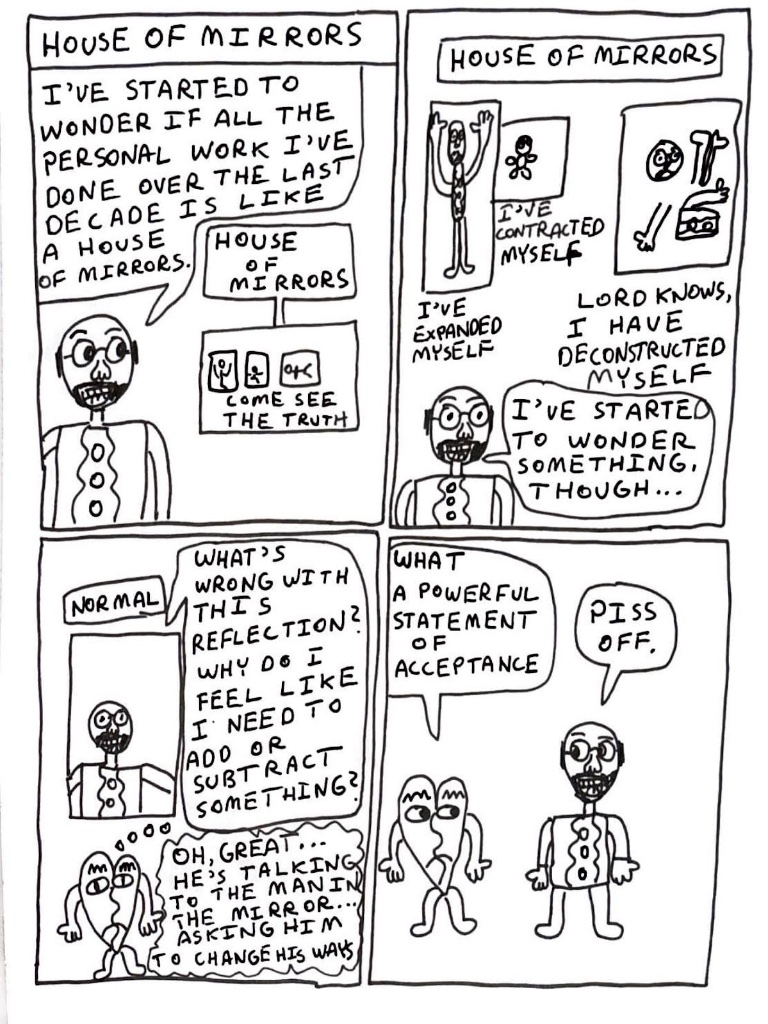
House of Mirrors

By Dusty McGowan

House of Mirrors

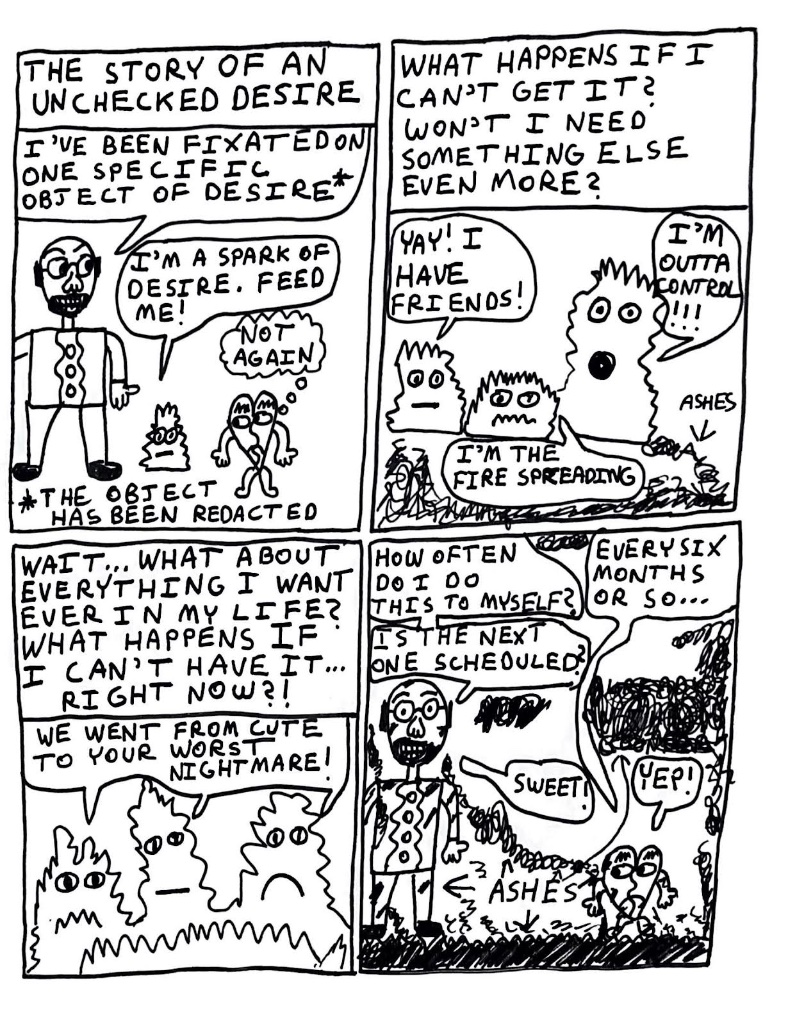
The Story of an Unchecked Desire

By Dusty McGowan

The Story of an Unchecked Desire

Poetry

Scent Holds Sentiment

By Iris Aloe

The closest we've been, today
In close to 4 months
And your cologne is driving me crazy,
I glance at your face, and I'm reminded,
You used to be my baby
And I feel so shameful,
That this sentiment still exists
Cause we ended in May,
Now summer is gone, and it's September
But our proximity is bringing me back,
To the days, when your hands
Resided on my waist
And he talked to me at the beginning of the proceedings
And I may have glared at him, in some fashion,
You get it
But the rest of hour where I'm facing you,
That's the main memory of my attraction
And my mind's filled with your image,
My eyes can't seem to leave,
Yours, staring down at the paper in front of you,
Half-wishing, you were reciprocating
So I'm messaging my friend, who's asleep
And expressing my continually bubbling frustration
Cause because societal expectations,
And feministic ideals
I shouldn't still be entranced,
I shouldn't still be where I am
Yet I am
And you're consuming all my creating,
You're my only muse at the moment,
Ugh
This potential chemistry is causing me so much calamity
And I realized this morning, around 8 am,
That our relationship, ran so much thicker than a thread
I realized I was in love with you, I still am,
Apparently
And unfortunately
That why I'm on edge every time we're in the same room,
No one could've or would've guessed you'd bring me to my doom
And then 9 am, you talk to me again,
You set off my anxiety
For the rest of today, terrified,
Of this afternoon meeting,
Where we will be forced share space
And then when I get there,
Someone catches my stare
And I was flirting a little bit,
Primarily to make you jealous
Oh shit, I'm sorry,
that makes me sadistic
I never intended for all this
But all I could envision,
Was your lips
And while my gaze was anywhere but your face,
I desperately desire your eyes on me, babe
I wanna see admiration, cause I still feel attracted,
And attached,
To you
Scent holds sentiment
That was the cause,
Of potential penitent

About the Author

Iris Aloe writes poetry, songs, musicals, plays, and screenplays, and has been doing so since she was 12. You can find her and her work on Instagram at @irisaloewritings, and on forwritten.com.

Wyoming Women

By Iris Aloe

If you had asked how I was doing today,
Instead of running off, to catch a glimpse of her face
You would know that I finally did a deep dive
On the place we're calling home
For the next 2 days
If you had only cared to make me feel cared
You would know
That today I learned Wyoming
Is an open carry state,
I saw a guy with a gun in the parking lot at the Walmart
If you had decided to be gallant,
And follow up on our enlightening conversings
You would've learned I live in a military family
So Mt Rushmore hit home
I severely appreciate the culture,
Of recognizing the veterans
That dedicate their lives, to let me live mine
If you had chosen,
To pursue an obviously amazing connection and chemistry,
Today I would've shared,
I disregarded your God-awful advice,
I looked up the location of the place we're going tonight
You'd hear how I went down the rabbithole,
Of Wyoming women wearing turquoise jewelry,
As an homage to the natives
They understand,
They occupy stolen land
And if you hadn't been willing to be coerced by her,
Maybe it would be my face,
Next to you
In the images you're taking
But you clearly didn't see, what I thought was crystal
So there goes,
Another potential person,
A guy who seemed just so great,
Right down the drain

About the Author

Iris Aloe writes poetry, songs, musicals, plays, and screenplays, and has been doing so since she was 12. You can find her and her work on Instagram at @irisaloewritings, and on forwritten.com.

Ashes

By Sofia Peralta

My fire burns down the trees so green,
Ravaged, in ashes, I'll leave.

Grass rustles beneath my heavy shoes
The shamrock fields, now charred–
As I run to escape the damage ensued

Gasoline tears wet the ground I pass,
My guilty steps, lit matches.

Every friend, every lover I set ablaze,
Lie helpless in glowing embers,
Scorched by our inevitable end.

I cannot smother the blaze of my trauma–
A relentless heat, it follows

An eternal sprint from flames, so red,
Away from the wreckage, my world undone–
The lands I've left in ruins

When will I finally face the damage?
How can I overcome the shame?

When will this burning finally cease?
How can I learn to regrow the trees?

About the Author

Sofia Peralta is a junior at Loyola University Chicago, studying healthcare administration, Spanish, and bioethics. Her first love is literature, and she has long been drawn to expressing abstract and complex emotions through poetry. Her work often explores themes of identity, trauma, and resilience. When not writing, Sofia enjoys visiting coffee shops, listening to Taylor Swift, and playing Stardew Valley.

Rainbow of Waiting

By Ibrar Sami

Behind the clouds, the sun hides its blushing face—
from within the winding path another path begins to rise.
I forget— that on this final evening, we were meant to walk a little farther together.

On the painted wall of my dream-lit heart, the torn dreams patch themselves together, sketching fragile images—
and from those sorrow-stained frames emerges a rainbow sky.
Beneath its shadow waits a humble, downcast woman.

In the dusty twilight of memory, I wander aimlessly;
the sun, bathed and weary, stands upon the border of pain—
and you are there, while I— let myself drift along the silent current of waiting, into the light of a rainbowed sky.

24 August 2025 – 1:35 PM

About the Author

Ibrar Sami is a Bangladeshi poet whose work moves through silence, memory, and the invisible borders that shape human existence. His poems often drift like nebulae—quiet, luminous, and charged with the tension of waiting—while tracing the fractures of a world stitched together by longing and shadowed history. Through images of cosmic distance, fragile unions, and blood-drawn cartographies, he explores how personal and collective memory overlap in haunting, intimate ways. His writing offers a collage of inner landscapes where silence becomes a language and the unseen becomes profoundly alive.

Silent Union of Waiting

By Ibrar Sami

Today, suddenly, I looked up at the sky— a single drop of rain fell, into the quiet wave of silence.

The wet air brushed my skin, my mind glowed with light— Om Shanti!

Darkness spread, like the hollow of deep stillness.

Four shadows walked together toward the far shore;
I stood apart and watched— in their hesitant eyes a hidden question gathered for me.

Touching the edge of unease, I walked through the evening veiled in nicotine smoke,
where in a cup of coffee lingered the silent union of waiting— as if from a distant nebula an invisible tune drifted near.

A coffee-thirsty stranger came close and said, "Brother, could you help a little?"
Another stood beside him, shining between laughter and shadow.

Winter rain fell, in the courtyard of cold, my hands grew numb.
Still, I looked outside— today the sky was dazzling,
yet I kept sinking into the depth of darkness, into the abstract union of light and shadow.

21 August 2025 – 7:35 PM

About the Author

Ibrar Sami is a Bangladeshi poet whose work moves through silence, memory, and the invisible borders that shape human existence. His poems often drift like nebulae—quiet, luminous, and charged with the tension of waiting—while tracing the fractures of a world stitched together by longing and shadowed history. Through images of cosmic distance, fragile unions, and blood-drawn cartographies, he explores how personal and collective memory overlap in haunting, intimate ways. His writing offers a collage of inner landscapes where silence becomes a language and the unseen becomes profoundly alive.

Silent Circle of Borders

By Ibrar Sami

Beneath a young woman's nightgown a fountain of desire breaks loose.
At midnight, in a flash of light, appears the invisible stain of blood.

On the wet earth lies a landless farmer's final hope— a chest full of ruin.

In the paddy field, motionless, a headless body lies;
the scent of grain mingles with the iron smell of death.

From afar— I only see the new colors of a map bleeding into the wounds of the old.

There was no fear then of a woman's violated body;
instead of bloodshot eyes there were eyes of honor.

Back then, freedom was ours— yours and mine— only the ways of using it differed.

By the railway tracks lies the throat-slit body of a young woman.
Around her stand countless silent faces, mere spectators.

No one looks away, only the sunlight burns the unseen wound within each soul.

I watch— a sculpture of endless inquiry, where new wine is poured into old, scarred bottles.

The city streets are no longer tarred, cracked like dry riverbeds.
In the far sky, migratory birds descend upon the circle of borders.

From their wings hang the shadows of unseen treaties;
others hover around the edges— with the signal of a single wing, the path of all is decided.

15 August 2025 – 7:35 PM

About the Author

Ibrar Sami is a Bangladeshi poet whose work moves through silence, memory, and the invisible borders that shape human existence. His poems often drift like nebulae—quiet, luminous, and charged with the tension of waiting—while tracing the fractures of a world stitched together by longing and shadowed history. Through images of cosmic distance, fragile unions, and blood-drawn cartographies, he explores how personal and collective memory overlap in haunting, intimate ways. His writing offers a collage of inner landscapes where silence becomes a language and the unseen becomes profoundly alive.

In the Pores of Silent Memory

By Ibrar Sami

From the ruins of an ancient city, I lift the scent of a single vertebra—
in the pale history of a sorrowful archaeology, particles of soil still hold the electrons of blood.

In the attic of the mind, funeral pyres blaze and burn the dead dreams;
suddenly awaken— the endless guilt standing in the shadow of extinction.

I see the forgotten faces, hear the equations of grief and weeping.

Day fades, night descends— beneath the city's ruins lies the blind chamber of death's agony.

Like a collage, in guerilla fashion, I gather the dark scripts of a hundred years' suffering.

No bodies remain— only the unbroken bones scattered through the corridors of consciousness, like a secret stealth exhibition.

I walk through the silent devastation; around me, the shadows of broken walls stretch long and coil around my feet.

Each existence suddenly collapses with a silent scream, asking— "Have you forgotten us?"

At every step, the raw scent of vertebrae enters my breath— sharp, lingering, like air bearing witness to an unseen crime.

The smell never fades, because— in every pore of history its trace still hides.

11 August 2025 – 7:25 PM

About the Author

Ibrar Sami is a Bangladeshi poet whose work moves through silence, memory, and the invisible borders that shape human existence. His poems often drift like nebulae—quiet, luminous, and charged with the tension of waiting—while tracing the fractures of a world stitched together by longing and shadowed history. Through images of cosmic distance, fragile unions, and blood-drawn cartographies, he explores how personal and collective memory overlap in haunting, intimate ways. His writing offers a collage of inner landscapes where silence becomes a language and the unseen becomes profoundly alive.

Collage of Cleavage

By Ibrar Sami

Now I know— the time has come for me to enter the war.
On the canvas of water unfolds the exhibition of your cleavage— before the final curve of your smile disappears, letters of red fire ignite in my chest:
"No freedom without resistance!"

I didn't yet understand— why the tender saplings on the rooftop garden suddenly lost their color, standing stiff and gray on the battlefield's edge.

Why, in the atoms of your body, is woven an unfinished declaration— "That's just how I am!"

Perhaps— when the last light of day dies, the roar of battle devours the dark.

Abstract shadows of waiting crawl like guerilla verses across my chest, drawing maps of fire— each line a slogan:
"Break the occupation!"
"Dispel the dark!"
"Raise the flag!"

Listen, comrade, listen— this war is not mine alone, it is yours, and his, and all who still keep their blood warm inside their hearts.

We will tear the face of night and raise the flag of dawn— until the last darkness melts into water beneath our feet.

14 August 2025 – 2:25 PM

About the Author

Ibrar Sami is a Bangladeshi poet whose work moves through silence, memory, and the invisible borders that shape human existence. His poems often drift like nebulae—quiet, luminous, and charged with the tension of waiting—while tracing the fractures of a world stitched together by longing and shadowed history. Through images of cosmic distance, fragile unions, and blood-drawn cartographies, he explores how personal and collective memory overlap in haunting, intimate ways. His writing offers a collage of inner landscapes where silence becomes a language and the unseen becomes profoundly alive.

Colony Drawn in Blood

By Ibrar Sami

One day, a secret blood-sucking mosquito drained a drop of blood from my body— that very day I realized— its thirst would one day reach the rivers within your body too.

Then, one day, our chromosomes merged in an invisible womb, and in a pillow of darkness was born an unfamiliar being— half light, half shadow.

Its face curves like a question mark, its roots of pain gather in every pore.

It sits inside the shadow, where noon is silent and evening exhausted.

It longs to rule— to tear apart the forest, to destroy the dreams of green wilderness, where humans build safe havens.

Hidden in its rage is the mark of a great sorrow.

It floats upon water, its stomach holds the hunger of birth, and in human blood it paints a dark, corrupted city.

The human body is its map— veins and arteries become the lines of a new colony.

Standing upon bridges of blood, it constructs an invisible empire— where blood, bodies, love— everything becomes its instrument of power.

Our blood merges with its hunger, and inside you and me it builds an unseen bridge— as if the chains of chromosomes bind even our existence into a colony drawn in blood.

17 August 2025 – 7:45 PM

About the Author

Ibrar Sami is a Bangladeshi poet whose work moves through silence, memory, and the invisible borders that shape human existence. His poems often drift like nebulae—quiet, luminous, and charged with the tension of waiting—while tracing the fractures of a world stitched together by longing and shadowed history. Through images of cosmic distance, fragile unions, and blood-drawn cartographies, he explores how personal and collective memory overlap in haunting, intimate ways. His writing offers a collage of inner landscapes where silence becomes a language and the unseen becomes profoundly alive.

Roar Remembered

By Callie Wyrsch

All he did was open my kitchen cabinet
And fear paralyzed every thought, every word, every sense
My heart dropped to my stomach like a rock
My eyes darted in every direction, searching for safety
In my own home

All he did was open my kitchen cabinet
And the roar of the tiger echoed in my ear
Clawing at the walls and furniture
Destroying what I had built
In my own home

All he did was open my kitchen cabinet
And I'm lying awake in the dark begging God for sleep
Isolated from the outside world's probing questions
To protect the undeserving tiger
In my own home

All he did was open my kitchen cabinet
But he wasn't the tiger disturbing the peace
The tiger had been caged months before
Why do I still feel so unsafe
In my own home

About the Author

Callie Wyrsch is a writer and poet whose storytelling began before she could write words. She holds a B.S. in Digital Media Productions from the University of Central Missouri and is the author of Connected and Uprooted. Her poetry has appeared in NoDivideKC's Our Identidad: Vol 2, Le Journal and The Siren, known for its emotional resonance and sharp social insight. Whether through narrative or caption, Callie's work invites genuine connection and uplifts voices often overlooked. Subscribe to her Substack: calliecw1217.substack.com. Follow her on Instagram and Threads: @calliecw1217.

Echoes of a Stolen Kiss

By Callie Wyrsch

Hot flash.
Goosebumps.
Heart thumps.
Toes curl.

Only six seconds
to steal a kiss in secret.

And the sweet spark from your lips,
left a permanent mark in my mind.

A moonlit memory of what might have been,
lingering intensity for infinity
dancing in my dreams.

The residue of what will never be
leaves me lonely and feeling bittersweet.

And we haven't spoken since.

About the Author

Callie Wyrsch is a writer and poet whose storytelling began before she could write words. She holds a B.S. in Digital Media Productions from the University of Central Missouri and is the author of Connected and Uprooted. Her poetry has appeared in NoDivideKC's Our Identidad: Vol 2, Le Journal and The Siren, known for its emotional resonance and sharp social insight. Whether through narrative or caption, Callie's work invites genuine connection and uplifts voices often overlooked. Subscribe to her Substack: calliecw1217.substack.com. Follow her on Instagram and Threads: @calliecw1217.

Burning Where You Left Me

By Callie Wyrsch

We haven't spoken since
From the crowd doesn't count
I was quite unhinged

What I thought was animosity
Morphed into yearning

I did this to myself

Some kind of hell

That I don't want to return from

About the Author

Callie Wyrsch is a writer and poet whose storytelling began before she could write words. She holds a B.S. in Digital Media Productions from the University of Central Missouri and is the author of Connected and Uprooted. Her poetry has appeared in NoDivideKC's Our Identidad: Vol 2, Le Journal and The Siren, known for its emotional resonance and sharp social insight. Whether through narrative or caption, Callie's work invites genuine connection and uplifts voices often overlooked. Subscribe to her Substack: calliecw1217.substack.com. Follow her on Instagram and Threads: @calliecw1217.

Mary and Larry's Score

By Uzomah Ugwu

Mary lay on coal, but it was too hot a release
What kept her still in the smoke was the comfort of
The ashes are more bearable than reality
Larry found her burnt being
He watched over her and couldn't let go
He saw her not be able to leave
All because of what she knew
She was trapped constantly in a life she did not
Want to lead, so she cooked and cooked the life off of her
But her past would not leave
They watched her from a distance but judged her as
close as they come to her
Larry loved all of her and what she thought she could
Never be
He saw her past in the ashes and the mistakes
That wouldn't leave long enough to find any peace

About the Author

Uzomah Ugwu is a poet/writer, curator, editor, and multi-disciplined artist. Her poetry, writing, and art have been featured internationally in various publications, galleries, art spaces, and museums. She is a political, social, and cultural activist. Her core focus is on human rights, mental health, animal rights, and the rights of LGBTQIA persons. She is the author of the chapbook The Triumph of Sorrow: A Lover of Longing. She is also the managing editor and founder of Arte Realizzata

trapped crawl

By Uzomah Ugwu

Hard and tough to
Describe
His Hands that Claimed Love
He wrote across her arms
Leaving scars
She wouldn't start to say
Where they came from, describing
Her attempts to crawl up walls
He trapped her with
her eyes on a door
That would remain closed
that didn't care
If her face was diced and beaten
Or bloody left her with promises
of defeat kept in what they made
a promise
He started to take
her hand like a knife
Cutting her belief that
What they had was a union
That's anything but him
Would suit her
when he was gone
Was not what she wanted
to see at her fallen days' dawn

About the Author

Uzomah Ugwu is a poet/writer, curator, editor, and multi-disciplined artist. Her poetry, writing, and art have been featured internationally in various publications, galleries, art spaces, and museums. She is a political, social, and cultural activist. Her core focus is on human rights, mental health, animal rights, and the rights of LGBTQIA persons. She is the author of the chapbook The Triumph of Sorrow: A Lover of Longing. She is also the managing editor and founder of Arte Realizzata

Sam

By Uzomah Ugwu

Isles of products hard to touch
Sounds, bang, bang, the mind
Angled foot steps with the temperature hot
As a heater is on in the coldest weather
Bang, bang, repeating in the corner of
Incomplete thoughts
Sam was a good girl
Isolated in her own world
That society refused to explore or let her explain
Under the assumption that her mind map had no direction
Disabled, she had to be to the point
Any ability she had couldn't be seen
Left shoes used and true
Tired of walking to closed doors
To classrooms that weren't made for her
To have a seat, the sounds are ringing
Can't find home again
A rising daughter shows her disability
As a ghost that haunts her

About the Author

Uzomah Ugwu is a poet/writer, curator, editor, and multi-disciplined artist. Her poetry, writing, and art have been featured internationally in various publications, galleries, art spaces, and museums. She is a political, social, and cultural activist. Her core focus is on human rights, mental health, animal rights, and the rights of LGBTQIA persons. She is the author of the chapbook The Triumph of Sorrow: A Lover of Longing. She is also the managing editor and founder of Arte Realizzata

on the sidelines

By Elmo Shade

all these distraught
disillusioned faces
flags fly upside down
bedtime stories without happy
endings the prince not
the frog the swan
not the duckling the lion king
never the elephant man
the faceless face down
clang tin cup coins
pavement scorches face flesh
voiceless chords
severed by sycophants
immigrants shackled and chained
dead man walking from
buried evidence
the homebound sit in sad
silence wait for weekly
meals from wheels punctured
by partisan privilege
a father works a double shift
his boy solo on a soccer sideline
a mother walks her daughter to
school not knowing it will be
the last time
a chained lab moans for his
missing master a refugee cries
for safety and a warm blanket
a woman's womb weeps

About the Author

Elmo Shade is a poet and author of The Dark Side of White Bread- Surviving Our Fathers: A Poetry Chapbook; Atmosphere Press; 2023, as well as three (3) additional poetry collections. He is the founder of the first Poetry Open Mic in Camas, WA, as well as Youth Uptown Poetry in Vancouver, WA. He currently serves as the Poetry Moves Director for Artstra, a local nonprofit 501(c)(3) arts advocacy group in Vancouver, as well as a volunteer for Meals On Wheels. His work has been published in The SubjectivJournal, Pointed Circle, Nine Cloud Journal, Western Washington Poets Network Anthology, Artstra Poetry Moves, Navy Pen Literary Magazine, and elsewhere. He is an avid fan of Italian Chianti, Opus-X Cigars, & RUSH.

When My Baby Brother Became John Denver

By Elmo Shade

For Doug

In December of '58, I wrote a letter to Santa asking for
a little sister on my 6th Christmas morning.

Instead, he brought a Johnny Reb Cannon, two pairs of
socks, and a new freckled-faced little brother.

I already had a little brother so confused as to why Santa
figured I needed another one.

We had the same color eyes, different sized ears, and we
parted our hair on opposite sides.

Growing up as siblings, we weren't exactly close. Six years
was quite the gap, like the old one between my front teeth.

When Doug was around twelve, he memorized all the chords to
Rocky Mountain High, playing it note for note on his Gibson.

He had also read through each volume of our family encyclopedia
and knew the definition of most words before I did.

His recollection was especially handy whenever I had an overdue
book report or if I needed a song to impress a first date.

And when my first dates never became second dates, he told me
I was "in love with being in love". Turns out, he was right.

A voracious reader, I thought he was too introverted to show any
signs of social intelligence. Turns out, I was wrong.

I felt genuine heartfulness in his voice moments after I called to
say my spouse had passed, hearing, "We're coming brother".

He was supposed to be the last man standing, not the first one to
leave. He was supposed to be the little sister I never had.

We had a three-way call days before his death. He asked about
grandkids, my sister-in-law's back issue, and what I was reading.

I can hear his spirit strumming as he climbs cathedral mountains,
sees the silver clouds below, sees everything as far as he can see.

About the Author

Elmo Shade is a poet and author of The Dark Side of White Bread- Surviving Our Fathers: A Poetry Chapbook; Atmosphere Press; 2023, as well as three (3) additional poetry collections. He is the founder of the first Poetry Open Mic in Camas, WA, as well as Youth Uptown Poetry in Vancouver, WA. He currently serves as the Poetry Moves Director for Artstra, a local nonprofit 501(c)(3) arts advocacy group in Vancouver, as well as a volunteer for Meals On Wheels. His work has been published in The SubjectivJournal, Pointed Circle, Nine Cloud Journal, Western Washington Poets Network Anthology, Artstra Poetry Moves, Navy Pen Literary Magazine, and elsewhere. He is an avid fan of Italian Chianti, Opus-X Cigars, & RUSH.

Stay Wild

By Elmo Shade

And then there are wolves, nocturnal creatures,
wild from birth, resilient from fear, who run in
packs, help raise their young, care for their sick.
Animals who mate for life.

And then there are hunters, gamers for the sport,
pride purveyors, fear mongers, blind following
the blind, like processionary caterpillars who
trample truth for profit and power.

Is this a world I want to see— attack dogs salivate
for chaos, the perishable purged by greed. Is what
I am seeing real if nothing real can be threatened,
if nothing unreal exists.

I resist anything or anyone who does not bring me
alive. I give gratitude for good trouble. I bow to
praetorian guards protecting our freedoms. I rest in
the cradle of kindness and kinship.

I plant ivy into the earth, dig my hands deep into
her seasoned soil, feel fortitude foreshadow our
future. I will run with the wolves. I vow to stay
willing. I vow to stay woke. I vow to stay wild.

About the Author

Elmo Shade is a poet and author of The Dark Side of White Bread- Surviving Our Fathers: A Poetry Chapbook; Atmosphere Press; 2023, as well as three (3) additional poetry collections. He is the founder of the first Poetry Open Mic in Camas, WA, as well as Youth Uptown Poetry in Vancouver, WA. He currently serves as the Poetry Moves Director for Artstra, a local nonprofit 501(c)(3) arts advocacy group in Vancouver, as well as a volunteer for Meals On Wheels. His work has been published in The SubjectivJournal, Pointed Circle, Nine Cloud Journal, Western Washington Poets Network Anthology, Artstra Poetry Moves, Navy Pen Literary Magazine, and elsewhere. He is an avid fan of Italian Chianti, Opus-X Cigars, & RUSH.

Murmuration

By Elmo Shade

Jet black-like smoke fills the sky. Sun darkens nearing dusk. Starlings,
thousands of them, a metallic sheen of glossy feathers mimic a cry for
protection from winter's storm. Long cone-shaped bills. Single fluid
masses of art morphing into a mesmerizing phoenix. Each swirl is like
a ballet orchestrated by an unseen conductor. My eyes are drawn upward,
tracing each movement, the way the flock seems to breathe as one entity,
pulses in perfect harmony as if the skies whisper secrets of things unseen.
I sear this image on my skin. I cry out for protection. Shield us with wings
that soar on your outer rims. Guard us from the talons of wealth. Purge us
from these political predators, their claws digging deep into our woke flesh.

About the Author

Elmo Shade is a poet and author of The Dark Side of White Bread- Surviving Our Fathers: A Poetry Chapbook; Atmosphere Press; 2023, as well as three (3) additional poetry collections. He is the founder of the first Poetry Open Mic in Camas, WA, as well as Youth Uptown Poetry in Vancouver, WA. He currently serves as the Poetry Moves Director for Artstra, a local nonprofit 501(c)(3) arts advocacy group in Vancouver, as well as a volunteer for Meals On Wheels. His work has been published in The SubjectivJournal, Pointed Circle, Nine Cloud Journal, Western Washington Poets Network Anthology, Artstra Poetry Moves, Navy Pen Literary Magazine, and elsewhere. He is an avid fan of Italian Chianti, Opus-X Cigars, & RUSH.

Roof Leaks

By Elmo Shade

The business card read, "Roof Leaks. Call Sam. Repairing
Roofs since 1989", stuck on the backside of my front porch
mailbox. How he knew my back patio shingled roof leaked
like bile ducts into a gallbladder, I never knew. I called him.

Sam arrived dressed in overalls and a red flannel shirt, his
worn cap tilted slightly sideways. Like his card, he seemed
a simple man, asking permission to access the roof from
the upstairs game room due to the steep loft. I hesitated.

A few days before Sam's arrival, brand new Berber carpet
had been laid preparing the loft space for a vacation rental.
What could go wrong? He's done this a gillion times. So,
I consented and waited downstairs while he worked.

"I'm almost done" he said "just need a bit more tar" as
he walked down the stairway and out the front door.

I quickly hurried upstairs to inspect his work. I gasped!
Just under the bay window were three black tar stains.

His apologies came quickly when seeing his careless steps.
He said he would only be a minute to finish the repairs &
at the same time, taking his shoes off, holding them as he
crawled back out on the shingled roof. Moments later,

I followed Sam to his truck, hearing his repeated apologies.
"I'm never this careless, Sir", in a humbled voice that echoed
past regret. "Wait until it rains and if your roof does not leak,
you can pay me then…or not." It rained. There was no leak.

Opening my mailbox to deposit his check, I was surprised to
see a letter addressed to me from Sam. And at the top was
a picture of a fine carpet, enough to cover his stains, and at
the bottom was a handwritten message from Sam. It read:

Dear Sir: Please use my fee to purchase this nice piece of
carpet to cover my sins. I am so sorry for my carelessness.
Please forgive me. Thank you for not yelling at me. -Sam

What price does a grown man pay at the cost of another man's
anger? How many times has he left a home feeling shamed
and humiliated. I said, "It's only carpet, Sam." His business card
reads "Roof Leaks. Call Sam. Repairing Men since 1989."

About the Author

Elmo Shade is a poet and author of The Dark Side of White Bread- Surviving Our Fathers: A Poetry Chapbook; Atmosphere Press; 2023, as well as three (3) additional poetry collections. He is the founder of the first Poetry Open Mic in Camas, WA, as well as Youth Uptown Poetry in Vancouver, WA. He currently serves as the Poetry Moves Director for Artstra, a local nonprofit 501(c)(3) arts advocacy group in Vancouver, as well as a volunteer for Meals On Wheels. His work has been published in The SubjectivJournal, Pointed Circle, Nine Cloud Journal, Western Washington Poets Network Anthology, Artstra Poetry Moves, Navy Pen Literary Magazine, and elsewhere. He is an avid fan of Italian Chianti, Opus-X Cigars, & RUSH.

Victim Impact Statement

By Arielle Arbushites

Anxiety is a second spine
and it sears as I look over my shoulder.
I watch the world in frenzied fragments:
rear view mirrors, shadows, attorney attaché cases—
this Protection Order in my pocket
is not bulletproof glass.

On edge, I remain in chaotic captivity
despite my escape from the hollow house
that had sent wrecking balls through my boundaries.

Instant panic floods my skin, blood, brain
at the sight of that vehicle make and model
and I'm afraid to play with my child in my own backyard.

Running on trails was once my prayer,
but the miles are stolen from me —
my second spine can't bear it.

Security footage, strangers warning me
I'm in danger, no sacred spaces remain;
he knows where I work, where I live,
where I pick up my morning coffee.

So expensive, this business of safety—
I've paid for it in sleepless nights,
in time off the job for court hearings,
in therapy copays, in cold hard cash
to law firms and copy machines.

Jumpy and jaded, I rise from the ashes
and take flight, my little one under my bleeding wing,
ferocious in my sanity and sheer survival.

I ask that the court consider the impact
these crimes have had on my weary soul
and impose a sentence that's just.

About the Author

Arielle Arbushites is a licensed social worker who has been a writer all her life. She lives and writes in Lehigh Valley, PA where she balances motherhood, hospice work, and poetry as a means of understanding what it means to be alive and connected. @writingthewayhome (Instagram)

Live Wire

By Praise Dominic

Shocks come in waves,
eyes locked in an intimate embrace.
Our hearts convulse to the rhythm
of lovers struck by lightning;
a current too wild to name.

This pull between us,
a live wire humming under skin,
threatens to burn through
the fragile fabric of reality.

About the Author

Praise Dominic is a writer, poet, and paranormal fiction author whose work explores emotional truth, transformation, and the mysteries that shape human experience. Praise has published essays and creative writing on Medium, where readers connect with the precision and depth of the writing. Praise's fiction and poetry combine atmospheric storytelling with a focus on personal evolution, creating work that resonates with readers drawn to introspective and imaginative narratives.

Static Embrace

By Praise Dominic

His arms leave me wrapped in static,
electricity pulsing through my skin
in the aftermath of our love.

My mind thunders with the storm
of our desires; lightning thoughts,
restless and bright,
refusing to fade.

The energy our love generates
could light a thousand cities,
power a million dams,
and rival the magnetic pull of the sun.

About the Author

Praise Dominic is a writer, poet, and paranormal fiction author whose work explores emotional truth, transformation, and the mysteries that shape human experience. Praise has published essays and creative writing on Medium, where readers connect with the precision and depth of the writing. Praise's fiction and poetry combine atmospheric storytelling with a focus on personal evolution, creating work that resonates with readers drawn to introspective and imaginative narratives.

Missing and Murdered

By Addey Christmann

How I am to pretend that the world
This shell of a home
-Is okay enough to raise our children in
When the streets are lit
Not with electricity and powerlines
That dance across the horizon
But with lights from candles that sway in the breeze
Over the loss of another son
The disappearance of another daughter
Whose name will go on a list to be covered with a thousand more
Darkness covering the earth we have known
Instead of the light that pours from the laughter
The smiles of the ones we have lost

The girl down the street went missing last week
Police refuse, to act, to care
The family patrol down dark alleys
Traveling hours to scour for the daughter
The sister, the niece, that they know is
Breathing in nothing but the stale flavor of dirt
Whose bones have become naked, only shielded by shrubs

The man across town, his body was found
Tossed in a culvert, hidden from sight
Not much of a condolence, not much healing
When his children consider at the hands of every person they meet
And wonder if they are stained with the blood of their father

How I am to pretend that the world
This shell of a home
-Is okay enough to raise our children in?

About the Author

Addey Christmann is an aspiring writer based in Eastern Washington and attending Central Washington University. Drawing inspiration from the desert of Washington and her time outside, she enjoys hunting, reading, and crocheting in her free time. She strives to bring the reader into the landscape of her poetry, and learn more about creative fiction. Previous work can be found in Manastash Volume 35: Spring 2025, "Yee Naaldlooshii" a short story fiction piece.

Flaming Land of Dry Lightning

By Addey Christmann

The strike of dry lightning sizzles and stings
The flavor of green leaving chlorophyll on my lips
Dripping in the blood of the forest and flora
That decorate the rising mountains and rolling plains
Is wiped out of the land and off of my tongue
Scorching the earth, hot and empty

Deer bound in a hurry over burning bushes
Nimble as they soar with invisible wings
Elk flee through traveled paths and trails
Barrelling their chests through the flaming twigs
Birds flutter in fear, their wings beating
In a rhythm that can be heard from miles away
Bears lope their massive bodies through brush and downed limbs
Loud and extreme in what once was their home

What will be left in what was once green and tan and yellow
Will be black and brown, soot drowning out the color of what once was there
No more flex to the branches, only stiff and begging to break
Under the weight of the age they once had
Death is spread across the floor
Of the creatures and their homes, the ones that didn't make it out

But in due time, there will be light
New growth will come
And little sprouts fight their way out to the sunlight
Squirrels create new burrows out of the dead
Rotting trees that lay on the soil

Life is a circle
Death is a circle
The only question is when the dry lightning will strike

About the Author

Addey Christmann is an aspiring writer based in Eastern Washington and attending Central Washington University. Drawing inspiration from the desert of Washington and her time outside, she enjoys hunting, reading, and crocheting in her free time. She strives to bring the reader into the landscape of her poetry, and learn more about creative fiction. Previous work can be found in Manastash Volume 35: Spring 2025, "Yee Naaldlooshii" a short story fiction piece.

wet words, wet rot

By Waverly Vernon

i cannot stomach the world we live in,
i cannot stomach the way it eats itself

it eats itself, i cannot stomach it

i go insane, pitch chairs through glass
want to pitch chairs through glass,
throw my body into a lit window

my body in a lit window,

scratching at my eyelids
my eyelids scratching

i see the edges of the sky blistering
the sky blistering at the edges

i walk the day's verge like a fray
i go about my day on the verge

of seeing everything too clearly
everything is seen too clearly

i can have all of this inside me
inside me i have all

and it still slides out as words
words slide out still

sick with awareness of blood on screens
blood on screens and streets

we say we love our country
i say i love my country

my heart is a fist in my chest
my chest has a fist for a heart

a gun cocked between my legs
there's a gun cocked under the table

and all i can do is this —write
write this down— all i can do

poetry, watching, fingering the pulse of rot
fingering the pulse of rot, watching the news

i do what i can
i do what i can

and still, it is never enough

i cannot stomach the world we live in

About the Author

Waverly Vernon (she/they) is a writer and interdisciplinary artist from Florida currently studying at the School of the Art Institute of Chicago. Their work explores politics, religious deprogramming, and trauma, transforming personal experience into connection and dialogue. They are the author of the micro chapbook "soft-skinned", published by Bottlecap Press. Their poetry has also been published by Wildscape Literary Journal, Creation Magazine, Arcana Poetry Press, among others.

Transcript of National Priorities

By Waverly Vernon

Your mouths are transfixed. Your feeds transfused. Your hands cannot stop transmitting the same sermon, transfixed on a decimal place in the census, transformed into centerpiece. Less than one percent, yet you transform calamity into chorus, every flood, every fire, every shooting transposed into your single grievance.

A man is shot in the street— transferred into your talking point.

Children dead in classrooms— transfigured into your suspicion.

Bridges collapsing— translated into your tired moral panic.

The obsession transcends reason. It is transhistorical, a transubstantiation of fear into doctrine. A transmission of decay into daily scripture. You transmute distraction into duty, transcribe hate as heritage, transpose every tragedy into your crusade. The real emergencies—poverty, storms, war—transferred to the background hum, while you keep shouting the same word.

Look at your obsession. Look at your transference. Look at the way your fixation transmogrifies into worship. You live by this transgression, you die by this transmission.

We confirm: this fixation is a transmutation of decay into spectacle. A transfusion of fear into loyalty. A translation of hate into policy.

This concludes the transcript. Please trans mit widely.

Please trans mit again. Please trans mit until no other message can be

heard.

About the Author

Waverly Vernon (she/they) is a writer and interdisciplinary artist from Florida currently studying at the School of the Art Institute of Chicago. Their work explores politics, religious deprogramming, and trauma, transforming personal experience into connection and dialogue. They are the author of the micro chapbook "soft-skinned", published by Bottlecap Press. Their poetry has also been published by Wildscape Literary Journal, Creation Magazine, Arcana Poetry Press, among others.

Current

By Cazoshay Marie

Current

About the Author

Artist, Writer, Speaker, Disability Advocate, Content Creator Creator/Moderator: Resilient Roots Support Group for Parents Living with Brain Injury Brain Injury Association of America Advisory Council Member Art Site: https://bio.site/collectedcazoshay

Permanent Regret, Irreversible Pain, Yad, A Tyrant

By Carmen Navarro

"We did everything right" they say,
While ashes of active destruction rain heavy upon the Bridge of Death,
As children catch the flakes in their bare, innocent hands like the falling snow of a cold early winter,
And families watch the fire saying "isn't it beautiful?"
But it's April now.

"That's impossible" they say,
While what appears to be a heavenly beam reaches out from the core into the young days new sky,
As the Cherenkov glow illuminates from the scattered debris and rests heavy on the graphite,
And ignorant men are sent to the crime scene,
Now laying in their lead-lined coffins.

"Don't cause a panic" they command,
While skin decays and faces appeared melted like old candle sticks,
As children play in the schoolyard, unaware that they swim in a sea of toxicity which will forever hinder their lives,
And too many more will be summoned.

"It's true," they now admit,
While tens of thousands of people search for somewhere new to call home, for where their hearts once used to reside is now 30 kilometers of excluded territory,
As almost all are told that their own bodies will soon betray them and never will they be able to live a normal life again,
And generations will suffer.

Dear grievous government,
Why did you take shortcuts?
Why did you not listen?
Why did you lie?

Chaos,
Heartache,
Eternal Rancor,
Nefarious Overcast-
Because You Lied.

Yad– Russian word for poison.

About the Author

Carmen Navarro is a senior at La Lumiere School in La Porte, Indiana. She has won various writing competitions and was awarded as the first Junior Poet Laureate of LaPorte County in 2023. Carmen often writes her poetry about political or social issues, connecting the main message in the poem with a relatable imagery. She is most inspired by the world around her and hopes to continue writing in the future.

Navy Pen

Issue 002 · Voltage

View All Issues